 how-to
How to Stop Spending Tax Money: A Guide for Self-Employed
Table of Contents
- Why Self-Employed Workers Spend Their Tax Money
- How to Separate Business and Personal Finances
- Create a Monthly Budget and Track Your Spending Habits
- How to Calculate Quarterly Estimated Taxes
- Automate Your Tax Savings to Prevent Overspending
- Best Tax Software for 2026 to Manage Self-Employment Income
- Address the Psychology Behind Lifestyle Creep and Spending Triggers
- Frequently Asked Questions
Last Updated: September 2, 2026
Why Self-Employed Workers Spend Their Tax Money
Self-employed workers face a problem salaried employees never encounter: taxes don't get automatically deducted. That $5,000 contract payment means the IRS expects roughly $1,200 by the next quarterly deadline. If you've already spent it, you're in a hole.
The root cause isn't recklessness, it's clarity. When you receive irregular income from multiple clients, it's genuinely hard to know what portion belongs to taxes, what covers business expenses, and what's actually yours to spend. Most self-employed professionals treat all incoming money as spendable until the tax bill arrives.
High earners often fall into lifestyle creep, increasing spending as income rises. A freelancer who lands a big project commits to new expenses before remembering that 25-30% of that income will vanish in taxes. The financial discipline required to separate these buckets doesn't come naturally with unpredictable income.
ClearNettCash was built to solve exactly this problem. By automatically separating taxes from your actual disposable income, the platform eliminates guesswork. You see three numbers: what you earned, what the IRS will take, and what's actually yours to spend. This clarity changes behavior.
How to Separate Business and Personal Finances
The foundation of not spending tax money is a clear separation between business and personal accounts. This isn't just accounting best practice, it's the difference between knowing what you can actually spend and guessing.
Open a dedicated business checking account separate from your personal account. Every client payment goes into the business account. Every business expense comes out of it. This creates a visible boundary that prevents accidentally spending tax money on personal items.

Once you know your actual disposable income (after taxes and business expenses), transfer only that amount to your personal account. This is the money you can safely spend. Everything else stays in the business account, earmarked for taxes and reinvestment.
Use separate credit cards too. Business expenses go on a business card, personal expenses on a personal card. This creates an audit trail and makes tracking your spending habits effortless. When tax time arrives, you're not digging through mixed transactions.
The tool you use matters less than consistency. A spreadsheet works. A dedicated accounting app works better. What matters is executing the system every single week.
Create a Monthly Budget and Track Your Spending Habits
A budget isn't a punishment, it's a spending permission slip. When you know exactly how much you can spend each month, you stop second-guessing every purchase.
Look at the last three months of income and calculate the average. This is your baseline. Now subtract what the IRS will take. Most self-employed workers underestimate their tax obligation by calculating only income tax. You also owe self-employment tax, which covers Social Security and Medicare. Together, these typically consume 25-30% of your net business income (irs.gov). Subtract your fixed business costs: software subscriptions, insurance, workspace rental. What's left is your discretionary spending budget.
Once you have your monthly budget, track where money actually goes in real time, not at month-end. Use an app, spreadsheet, or notebook. The format doesn't matter, seeing where money goes while you still have time to adjust does.
Identify your spending triggers. For some people it's stress, for others social pressure, for others boredom. When you know your trigger, you can plan around it. If stress spending is your weakness, build a small buffer into your budget for that. The 24-hour waiting rule works: before any non-essential purchase, wait 24 hours. Most impulse purchases disappear after a day.
How to Calculate Quarterly Estimated Taxes
Quarterly estimated taxes are due four times per year: April 15, June 15, September 15, and January 15 (irs.gov). The IRS expects you to pay roughly 25% of your annual tax liability in four equal installments. Not paying quarterly results in penalties and interest.
The calculation has three steps. First, estimate your total business income for the year. Second, subtract your business expenses, client gifts, software, equipment, workspace, professional development. Third, apply the self-employment tax rate (approximately 15.3% on 92.35% of net income) plus your federal income tax bracket (irs.gov).
The formula is complex enough that most self-employed workers use a calculator or accountant. The IRS provides Form 1040-ES with a worksheet that walks you through the math. Many tax software platforms have built-in estimated tax calculators.
The discipline part: the moment you calculate what you owe, transfer that amount to a separate savings account. Don't touch it. When you see money sitting in this account, it stops feeling like spending money. It's tax money. The psychological shift is crucial.
Automate Your Tax Savings to Prevent Overspending
Automation is the difference between good intentions and actual results. When tax savings happen automatically, you can't accidentally spend the money.
The simplest automation is a recurring transfer. Every time you receive income, transfer the tax portion to a separate savings account immediately. Don't wait until month-end. The moment money lands in your business account, move the tax portion out. This creates a system where you're never tempted to spend it.
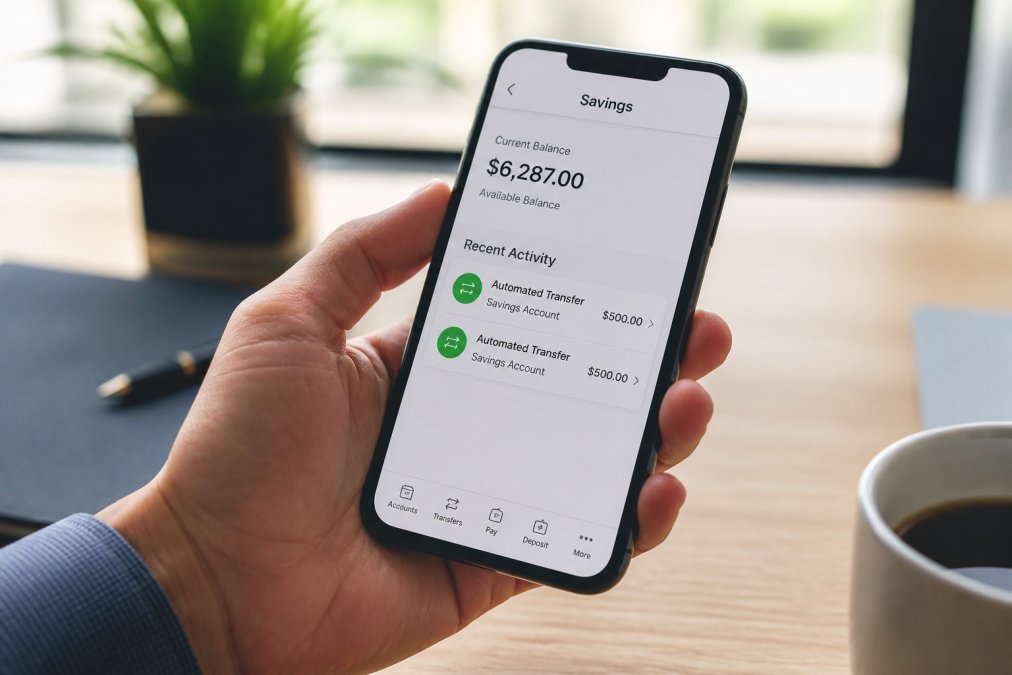
The second automation layer is your business expenses. Many accounting platforms allow you to categorize transactions automatically. Set up rules so every invoice payment, software subscription, and business purchase is tagged and tracked without manual entry.
The third layer is your personal budget. Once you've calculated your true disposable income, automate a transfer to your personal account. This is the money you can spend guilt-free. Everything else stays in the business account. The automation removes daily decision-making.
The real power of automation is that it changes your identity. You stop being "someone trying not to spend tax money" and become "someone with a system."
Best Tax Software for 2026 to Manage Self-Employment Income
Choosing the right tool matters because you'll use it every week. Look for software that handles self-employment specifically. Generic budgeting apps don't understand quarterly taxes or the unique cash flow challenges of freelance income.
Key features to evaluate: Does it automatically separate taxes from your actual income? Can it calculate quarterly estimated taxes? Does it track business expenses by category? Can it integrate with your bank account? Does it generate reports for an accountant? Does it handle multiple income streams?
Many freelancers use a combination approach: dedicated accounting software for business income and expenses, then a budgeting app for personal finances. This separation mirrors the mental model, business money and personal money are genuinely different things.
ClearNettCash is specifically designed for this problem. It automatically separates taxes and business costs from your total income, so you always know exactly what's yours to spend. The platform handles irregular income, multiple income streams, and the psychological challenge of not spending tax money.
Address the Psychology Behind Lifestyle Creep and Spending Triggers
The numbers matter, but psychology matters more. You can have the perfect budget and still fail if you don't understand why you spend money.
Lifestyle creep is the silent killer of self-employed finances. You land a big contract and feel wealthy, then commit to expenses you can't afford when the contract ends. The fix: when income increases, put 70% toward taxes and savings. Only spend 30% on lifestyle improvements.
Spending triggers are the immediate reasons you spend impulsively. Stress spending happens when anxious or frustrated. Boredom spending happens when not busy. Social spending happens when friends spend. Reward spending happens after completing projects. Recognizing your trigger is the first step to managing it.
The solution isn't eliminating spending, it's planning for it. If you stress-spend, build a small "stress fund" into your budget. If you reward-spend after projects, plan a specific reward. If social pressure drives spending, commit to one "no" per outing.
The visibility problem matters too. When you see all your money in one account, it feels spendable. When separated into "taxes," "business expenses," and "personal spending," the taxes portion stops feeling like yours. This is exactly the point.
The gap between earning money and knowing what you can actually spend is where most self-employed professionals get stuck. You solve this with three things: a system that separates taxes and expenses from your real income, the discipline to stick with it, and psychological awareness of your spending triggers.
ClearNettCash automates the first part. It separates taxes and business costs automatically, so you always see your true disposable income clearly. This clarity eliminates guesswork and anxiety. Get started with ClearNettCash and stop wondering whether you're spending tax money, know for certain that you're not.
Frequently Asked Questions
How do I stop spending money that is meant for taxes?
The most effective way to stop spending tax money is to physically separate it from your personal spending funds. Open a dedicated savings account for taxes and set up automatic transfers each time you receive income. If you earn $2,000 and owe roughly 25-30% in taxes and business expenses, transfer that amount immediately to your tax account. This removes the temptation to spend it on personal expenses. Many self-employed workers find that out-of-sight funds are out of mind, making it harder to tap into money designated for tax obligations.
What is the best way to separate business income from tax obligations?
Start by opening a separate business bank account from your personal account. Deposit all business income into this account, then transfer your personal draw to a personal checking account. Use accounting software or a spreadsheet to track which portions of your business income belong to taxes, business expenses, and personal income. Many self-employed professionals use the 30% rule: set aside 30% of gross income for taxes and quarterly estimated tax payments. This separation creates a clear visual boundary and makes it harder to accidentally spend funds that belong to the IRS.
How can I calculate my quarterly estimated tax payments?
Quarterly estimated taxes are due on April 15, June 15, September 15, and January 15. To calculate your payment, estimate your annual net self-employment income, apply the current federal tax rate (consult IRS Form 1040-ES for your income bracket), and divide by four. If your income is irregular, you can adjust payments based on actual earnings each quarter rather than making equal payments. The IRS provides worksheets on Form 1040-ES to help with this calculation. Many tax software tools for 2026 automate this process by tracking income and calculating what you owe based on real numbers rather than estimates.
What happens if I spend my tax money and cannot pay the IRS?
If you cannot pay taxes owed, the IRS charges penalties and interest on the unpaid balance. Penalties start at 0.5% per month of the unpaid tax, and interest compounds daily. If you underpaid quarterly estimated taxes, you may also face an underpayment penalty. However, if you cannot pay in full, the IRS offers payment plans and offers in compromise for qualifying taxpayers. The key is to file your return on time even if you cannot pay immediately. Failing to file or pay triggers much steeper penalties than working with the IRS on a payment arrangement.
This article was written using GrandRanker